Interview: Pierre Castignola - Uncovering the symbols hidden in everyday life through design
Pierre Castignola is a French designer based in the Netherlands. After graduating from the Design Academy Eindhoven in 2018, he established his own studio. His work ranges from everyday objects and furniture to installations, and through his work he questions conventional thinking about what we want from objects and the relationship between people and objects.
First, please tell us about your background and activities.
My name is Pierre Castignola. I'm a French designer currently based in the Netherlands. Immediately after graduating from Design Academy Eindhoven in 2018, I set up my own studio and have been creating a wide range of works, including furniture and installations.
What made you decide to move to the Netherlands, even though you grew up in Paris?
At the time, I wasn't sure what exactly I wanted to pursue. I moved to the Netherlands at the age of 19 with the intention of exploring different fields. I chose Design Academy Eindhoven because it was a school that welcomed a multidisciplinary approach. Other schools would have pushed me to specialize right away, but I felt I needed time to experiment with different media.
I heard that you started to show interest in design at the age of 13. What was the trigger?
I decided I wanted to be a designer when I was 11 years old. There was actually a clear trigger. At the time, my father took me to the Paris Motor Show, where Ferrari was unveiling their new car, the 599 GTB. I went right up to the fence and stared at the Ferrari for about 45 minutes, analyzing and observing every detail. That's when I decided I wanted to be a car designer. When I told my father, who was an industrial designer, about this, he explained that I needed cultural knowledge and artistic skills, so from then on I started going to exhibitions twice a month and taking art classes.
After a while, I no longer wanted to be a car designer, but my love for cars remains the same. At the time, I couldn't touch, ride in, drive, or even buy that car, but I was still fascinated by it, and even now, when I think back on it, I'm impressed by the power of design. This experience was the beginning of my interest in icons and semiotics. I started reading books to understand them, and later started working as a designer with that theme in mind.

I'd like to ask you about your early work, " State of Possessions ." This project intentionally does not aim to directly address the needs of users, but rather invites humans to adapt to the properties of the object. For example, a lamp will only light up if it is intentionally tilted at a specific angle. It aims to move away from the master-slave relationship humans have with objects, and can also be seen as a critique of mass production and the socio-economic systems that shape it. How did you become interested in this perspective?
While "State of Possessions" can certainly be seen as a critique, I see the work simply as my own approach to mass production, consumption, and planned obsolescence. I've always been fascinated by how we relate to objects and why we now feel so little attachment to our possessions. For example, if you lose your current mobile phone, would you feel sad about it? For me, it's not so much sad, it's more like a bit of annoyance. The only emotional response to loss is the loss of data, including photos that can never be retrieved.
This means we have little interest in the objects themselves, and little reason to own them. Things are easily replaceable and are designed to be replaceable. Objects tend not to last long in our lives, and are designed to break down over time through planned obsolescence. The time we share them is short, so we don't develop any attachment to them, and we don't even have time to form feelings towards them.
"This background and thought was my starting point, from which I began to explore how I could manipulate the design of an object and incorporate emotional responses into the design process. I felt strongly that the relationship between user and object needed to be changed. That's why in State of Possessions, I removed the typical button switch from the lamp and deliberately made the interaction more complex, forcing the user to put in effort when using the lamp."
I try to explore the sensual side of objects through my designs. It's a theme that still influences me a lot and I continue to think about it. I would say that the relationship between humans and objects is now the foundation of my practice.


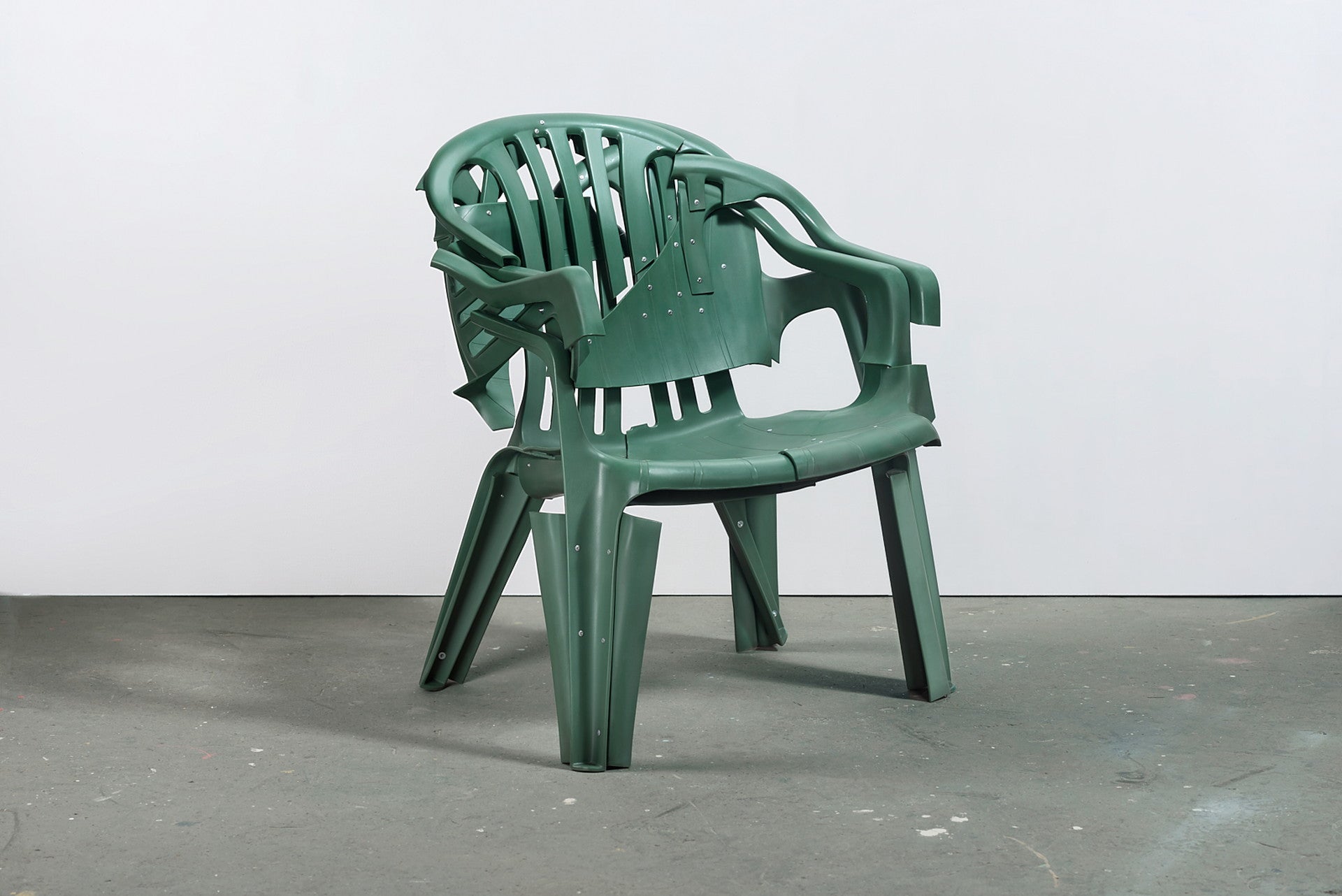
The title of the series " Copytopia " seems like a carefully chosen copy to symbolize the concept of the series. Could you explain the research and thinking that went into creating this series?
It all started with me wanting to better understand how intellectual property works. Before I started researching, the intellectual property system seemed logical, but the more I looked into it, the more I realized it was just a tool for creating monopolies. I envisioned Copytopia as a creative utopia where people could freely build on each other's ideas.
I later learned that the creator of a famous plastic chair remains unknown. The inventor never filed a patent, and now many copies are patented and copyrighted. This highlights the hypocrisy of companies that try to own something they didn't originally create. With this in mind, I wanted to collect plastic garden chairs from various manufacturers, cut them up, create new designs, and ask the question: "Whose intellectual property is this?"
What first got you interested in intellectual property?
It all started when I tried to copy a 20 euro note on a photocopier. The printed paper was covered in stripes, a safety feature built into the copier. It was my first encounter with intellectual property-related limitations, and physical limitations at that. From there, I slowly started to read a bit more on the subject, and one of the books I read, "In Praise of Copying" by Markus Boon, was an eye-opener. In this book, Boon explores the various aspects of copying in different fields, and it had a huge impact on me. I became more interested in the philosophical, anthropological, and economic aspects of copying.


You often work with signs and symbols: Copytopia, for example, is an obvious reference to the famous plastic chair, and more recently you designed a folding outdoor table reminiscent of a picnic table, as well as a faithful copy of the iconic lounge chair designed by Swiss architect Pierre Jeanneret . Why are you drawn to semiotics and symbols?
I love the idea of icons, I'm simply fascinated by them, and I've always wanted to know why certain things are so iconic. The plastic garden chair is one example. No one can easily explain why that chair became so well-known. Maybe it's because so many people have strong opinions about it. People either love it or hate it, and I've even seen people become fanatically attached to it. I find that phenomenon in itself fascinating.
Using iconic representations is very important to me because by working with them physically and conceptually, I can tap into the emotions that the audience has towards the object. Whatever emotions they may have, they can evoke something. For me, working with such objects is essential. The decision of which symbols to work with is very personal and biased, but at the same time, I think it is a good opportunity to bring my thought process to the surface.
Regarding your design process, do you start by researching a subject that interests you, or do you tend to think about the form first?
To be honest, it depends, but I often start with a rough concept in mind, with no particular structure in my head. By giving it form, I feel like I'm proving my thinking, but in reality, my main goal is to try to understand what I'm thinking. However, sometimes an impulsive idea pops up and I feel a strong desire to put it into practice immediately. For example, the picnic table I mentioned earlier came about when I found a broken picnic table in a charity shop while working on Mini-Golf Extravaganza with Ugo Belleguerai and Diego Febvre as part of Milan Design Week . It felt like something I'd never seen before, and I vividly remember being very excited at the time.

There seem to be many surrealist influences in your work, such as your chandeliers, which combine function and material in unexpected ways . Are you naturally drawn to surrealism?
I think the surrealist elements come from the context of each piece. I like to transpose objects by changing their context. For example, the chandeliers inspired by the Palace of Versailles in France were symbols of immense wealth, made with the most precious metals and craftsmanship. By changing the perceived order of the chandeliers while keeping the same form, I am able to give them a completely different feeling than they originally had.
I love surrealism because it makes this possible, and it gives you the feeling of stepping away from reality, almost like reading a fantasy novel. I once worked with photographer Ronald Smits , and he would draw the line when a photograph started to become surreal. Having witnessed his preference, I realized that I had a strong desire to go even deeper.
Reality only interests me to a certain extent. Perhaps I have a natural desire to create something "fantastic" from everyday materials. In that sense, you could say that the objects I make slightly distort reality in ways that differ from their original purpose. In fact, I'm naturally drawn to contemporary artists, so I've never studied the masters of Surrealism in earnest. That said, when I work with inexpensive, undervalued materials, I feel I have no choice but to add a certain new value to my work in order to make it impactful.


Perhaps due to the surreal elements, your work seems to have the power to expand the imagination, making us think, "What if there was a timeline like this?" Is it something you consciously aim to create?
Actually, I've always thought of "Copytopia" as an exploration of another world. "Copytopia" is obviously a reference to the term "utopia," but I approached this project with the same approach as Thomas Moore's books. The concept of "utopia" being an unattainable best-case scenario, and its opposite, "dystopia," being a more realistic worst-case scenario. I'm interested in this theme and have been researching it a lot. Reality simply oscillates between these two worldlines, and by considering the best-case scenario, we can reflect on our current state. Are we closer to the best? Or closer to the worst?
Do you create several prototypes or mockups before finalizing a design? Can you tell us about the process you typically follow?
When I have an idea, I start by making a drawing and then work from there. The drawing is only a base, a very rough guideline for me. It's impossible to plan every complex shape in advance, so it's more like an exercise that I've refined over time and experience. All construction is improvisational and involves a lot of trial and error. A few years ago, I started working with plastic tables, which required a new approach, as every cut had to be precise and measured. Because I only work on one object, if I feel like I'm going in the wrong direction while working, I often take a few steps back and start again with a different approach. Focusing on one piece at a time can be a long and tedious process, but it's still a lot of fun.

You have worked with a lot of plastic and aluminum, but you have also produced works using ceramics . How do you choose your materials?
I choose materials mainly based on my interest at the time and whether they will strengthen the concept. I've been working with plastics for a long time, but I'm currently working on projects using new materials, which gives me more room to experiment. I really enjoy experimenting with new materials because it forces me to adapt my usual process and spend time understanding what I'm doing, what it can do, and how to do it.
What fields or areas do you draw inspiration from?
I'm mainly influenced by other designers, especially the Memphis Masters, a group of designers active in Italy in the early 1980s, and the writings of Roland Barthes, but it's difficult to name any particular ones.


You've said in previous interviews that you're deeply influenced by Roland Barthes' semiotics. Do you ever draw ideas from books on design or cultural theory?
Yes, quite often. Roland Barthes is definitely my biggest influence, and the way I think and see the world resonates with him the most. I'm actually quite curious, and I think I can become interested in any topic if it's explained well. And, of course, the knowledge I gain influences me, probably subconsciously. I often unconsciously store in my head a story, piece of information, or something else that interests me, and it resurfaces at some point and I want to create something based on it.
Barthes is known for writing in Empire of Signs that Japan is full of various symbols, from concrete to abstract, such as the everyday gesture of bowing or the graphic elements of Japanese cuisine. You have been heavily influenced by Barthes, but how do you view Japanese culture?
"Empire of Signs" is my favorite book, and it inspired me to visit Japan and explore the country one day. I've read it many times, and each time I find new interpretations. My symbolic work is very Western-based, incorporating images from my childhood and my current lifestyle. Transposing them into the context of a country on another continent allows for entirely new interpretations, and of course, my work is viewed from a different cultural perspective. I hope to one day have the opportunity to create work from this perspective. I'm also inspired by Japanese writers and architects such as Haruki Murakami, Tadao Ando, and Shigeru Ban, and I often create while listening to Japanese disco music like Tatsuro Yamashita and Masayoshi Takanaka. I'm also interested in many Japanese subcultures, such as the straight pipes used by bosozoku (bōsōzoku) and JDM, and I often wish I could learn more about them.
Are there any other writers who have had a major influence on you?
Barthes is undoubtedly my biggest influence, but Marcus Boone's "In Praise of Copying" is my second biggest. I've also been influenced by Yanagi Muneyoshi's "The Law of Beauty" and Dejan Sudjic's "The Language of Things." To me, both seem like hymns to observing our surroundings, so I feel they share a commonality with Barthes. I'm also interested in philosophy, and Aurelius' perspective has always intrigued me, especially given his social position. More contemporary, I've been heavily influenced by sociologist Richard Sennett.

You have designed a variety of objects, including tables, chairs, stools, charging stations, vases, wall shelves, and candlesticks. Is there anything else you would like to design in the future?
I love designing all kinds of objects, especially those with specific purposes like folding picnic tables, or interesting objects that seem almost obsolete, like lava lamps. Designing a new object means exploring new disciplines, visual languages, taxonomies, and the various archetypes and icons that surround it, as well as our perception of the object. I'm currently working on several projects, one of which is designing an office chair. It's very exciting because it's the first thing I've designed. It requires me to gather a lot of information and make conscious decisions based on that research, which is a lot of fun.
Can you tell us a bit about some of the projects you have in the works that haven't been announced yet?
I'm currently working on several projects. I recently released a series of small objects called "Petra," which are ceramic reproductions of plastic chair parts. I'm also working on an office chair that I'll be showing in a group exhibition with Uppercut in Belgium in November.
I am also currently working on a project to design an entire space as an installation, which will challenge me to significantly scale up my work, but I have not yet decided where to exhibit it.
I'm also currently working on my biggest project to date, which I've been working on for the past two years. It's scheduled to be completed by November, and it's the project I'm most excited about. I want to show it to you all soon, but it's not ready yet, so I want to surprise you, so I hope you'll look forward to it.

Tsukasa Tanimoto
