Interview: Nicolas Zanoni - Design that manipulates materials to their limits
Nicola Zanoni is a Parisian-born, Argentine-born designer based in Brussels. He explores the possibilities of materials, creating pieces that simultaneously evoke a sense of déjà vu and surprise. Balancing functionality and symbolism, he develops his unique designs through pieces that fulfil practical needs while also stirring the emotions of the viewer.
First, please tell us about your background and activities.
My name is Nicola Zanoni. I was born in Paris, France, but my father is from Argentina. I lived in Paris until I was 18, then moved to Brussels to study Industrial Design at La Cambre. While gaining a foundation in object design and production, I found myself drawn more to research, experimentation and problem-solving than to the finished product.
After graduating from graduate school in Brussels, I continued my research and began exhibiting my work, which has led to my current activities. Even now, I always keep research and development in mind when working on designs.

Can you tell us about the environment you grew up in?
I grew up in Paris, so I spent my entire childhood and adolescence there. Paris was like my playground, but as I grew older, I found myself longing for new environments and new encounters. In that spirit, I think Brussels was the city that broadened my horizons as a young person at the time. I currently live between Paris and Brussels, but my studio is in Brussels.
I'm also very proud of my Argentine roots, having visited there frequently since I was little and my whole family still lives there. I love going back to Buenos Aires because there are so many people who share my taste in art and other things. The city itself is a big inspiration to me.
I heard you skateboarded as a child, and that experience seems to be incorporated into your designs. How do you think your upbringing has influenced your current activities and approach to design?
From a young age, I was immersed in the world of skateboarding, roller skating and skate parks. I didn't practice skateboarding much, but I was totally immersed in freestyle biking (FGFS). It was my daily life!
Those interests formed part of my personality and I think they are reflected in my work today, especially the humorous and playful touches they have. I think it also influences my aesthetic. I'm really drawn to machined and anodized bicycle parts and the specific screws and technical details that are present. I take design very seriously, but at the same time, I see it as a way to push myself. It's kind of like landing a trick on a skateboard: you try and try, sometimes you succeed, sometimes you fail, but in the end it's all about having fun!

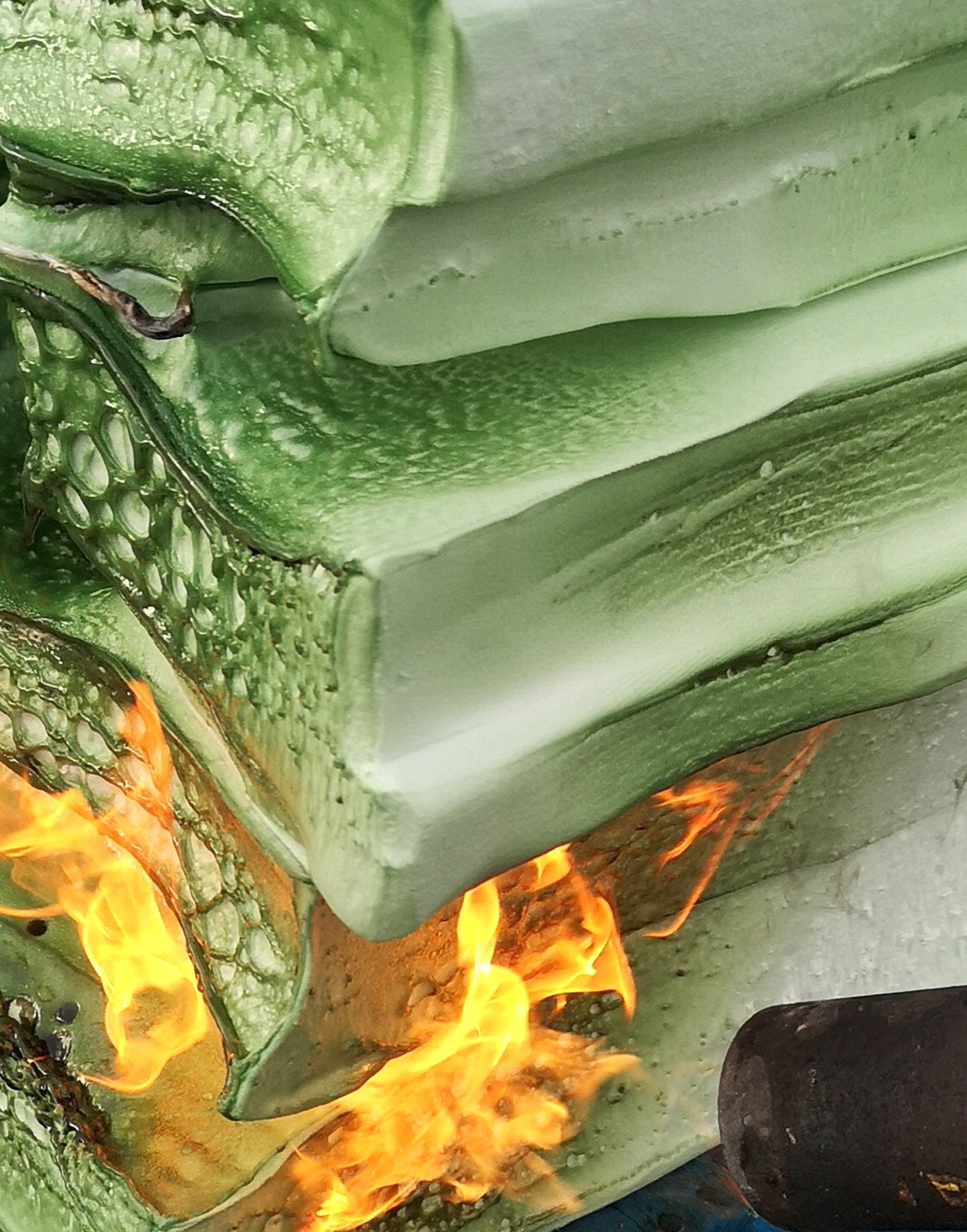
Your work seems to foster an element of attachment, perhaps because you transform familiar materials in unexpected ways. I think you evoke a sense of déjà vu through industrial materials, while evoking a sense of preciousness through the handmade look. For example, you previously designed furniture using burnt styrofoam . Is this approach a key element in your own designs?
Materials are definitely at the heart of my designs. I love exploring the possibilities of each material and creating surprising results. Experimentation is at the heart of my process, which often leads to unexpected results. I think what interests me is playing with expectations, transforming familiar materials to provoke different reactions, new perspectives.
I don't necessarily aim for my work to be "precious" in the traditional sense. Sometimes I achieve forms and textures that deliberately provoke feelings of uneasiness or even repulsion. But what I find most fascinating is that the effort to work with a material, to "craft" it, gives it a certain value. I like to play with our preconceived notions of certain materials, using processes that are often applied in other contexts. For example, I recently used a hammer and chisel to carve pressed styrofoam sheets.

I don't have a hard and fast process for selecting materials; rather, I rely on intuition. I'm often drawn to industrial or everyday materials for the quality of their texture, shape, or response to any kind of processing. I'm particularly intrigued by materials that may seem mundane at first glance, but that reveal surprising properties through experimentation.
I'm fascinated by the contradiction between an object's inherent function and the possibility of transforming it into something completely unexpected. I think I'm looking for properties like malleability, the ability to transform, or the ability for the surface to react in interesting ways to certain treatments. In short, I'm looking for materials that can transcend their usual limitations and reveal something new.
I previously read on Instagram that experimentation is your favorite part of the project. What process do you typically follow when creating a piece?
It's true that experimentation is truly my favorite part of any project. I always start with a vague idea or intuition, so I never start with a very precise vision. I like to leave a lot of room for the unexpected. Unexpected shapes and concepts emerge from my experimentation, guided by the reactions of the materials and the experimental process. I'm happiest in the studio, instinctively trying different things.
Sometimes I start with an idea, but even then I jump right into experimenting, because I think that only then does it feel like it's starting to take shape. I try different processes, pushing the materials to their limits and seeing how they react. Through this process, a body of work or a small collection is born, but the experimentation also leads to other new ideas.
Your work seems to be at the crossroads between furniture and sculpture: on the one hand, function is paramount, and on the other, symbolism is often key. Are you interested in both aspects?
Certainly, my work lies at the intersection of furniture and sculpture. The functional aspect is always present, but I don't see it as an absolute requirement. I'm primarily interested in exploring materials and how they can evoke emotions and concepts. So, if anything, symbolism is central to my process.
That said, I don't choose between functionality and symbolism. I see them as two aspects that coexist and influence each other. Sometimes a work arises from a purely sculptural idea, but by giving it a function it becomes a way to add a new layer of meaning. Sometimes, function guides the form, of course, but I never separate it from my artistic taste. The dialogue between these two extremes is at the heart of what I do. I see function as a language, a medium of expression. At the moment I tend to follow the importance of functionality, but sometimes my instinct is to ignore it altogether.

Many of your works seem to combine cuteness with a certain coldness. For example, in your "Spinner" series, you combine roller skates with stainless steel, which seems to achieve that balance. Is this approach something you are intentionally aiming for?
That's interesting! I think my work reflects who I am, and personally I like to walk the line between being serious and being playful. I take my work very seriously, but adding some irony and humour is essential.
By playing with this contrast, I aim to create work that can be perceived from different perspectives: light and playful, but also thoughtful and symbolic. By mixing seriousness and lightness, I hope to make design more accessible.

I sense a subtle relationship between your everyday life and your work. For example, some of your works contain references to skateboarding , climbing , and smoking . What do you think about the potential for drawing on personal experiences to produce unique works?
That's definitely true. I think drawing on personal experiences is a very reliable way to create unique work. What I experience on a daily basis naturally influences my work. What I do and think on a daily basis is, of course, part of my identity and will be reflected in the visual vocabulary of my work. I believe that incorporating elements of my personal life into my work allows me to infuse it with a sincerity that anyone can immediately relate to.

Do you ever get inspiration from the people you share your daily life with or work with?
I'm lucky to live in Brussels, where the art community is very active. I used to work in a shared studio and have been heavily influenced and inspired by other artists. I really value feedback on my practice, whether positive or critical. I currently share a studio with three collectives: Espace Aygo , touche-touche and Ori Orisun . Being surrounded by people I respect is a huge source of inspiration and motivation.

I'm curious about what kind of music you listen to at work and in your private life. Can you tell me some of your favorite songs?
Of course! I'll share my playlist with you. It's in order of my most listened to songs!
Can you tell us a bit about the new work you're currently finalizing?
One project I've been working on recently and very positively is opening a workshop space in Brussels with some very dear designer friends. We're still in the early stages, but we have lots of ideas for how to personalize the space and make it accessible to visitors. I look forward to sharing more details when we're at a more advanced stage!

Tsukasa Tanimoto
