Interview: Kasper Kyster -New Craft: Combining Tradition and Innovation-
Danish-based designer Kasper Kyster is active in a wide range of fields, from designing innovative furniture to curating as one of the founding members of Ukurant, an organization that supports young designers. Since earning a Master's degree in Furniture Design from The Royal Design Academy in Denmark, he has continued to create furniture with his own hands, and this year he held his first solo exhibition at 3 Days of Design. His work skillfully combines functionality and beauty, creating designs through experimentation with materials. His contemporary approach to craft reflects the fusion of tradition and innovation, leading to new values in design.
What do you keep in mind when designing your work?
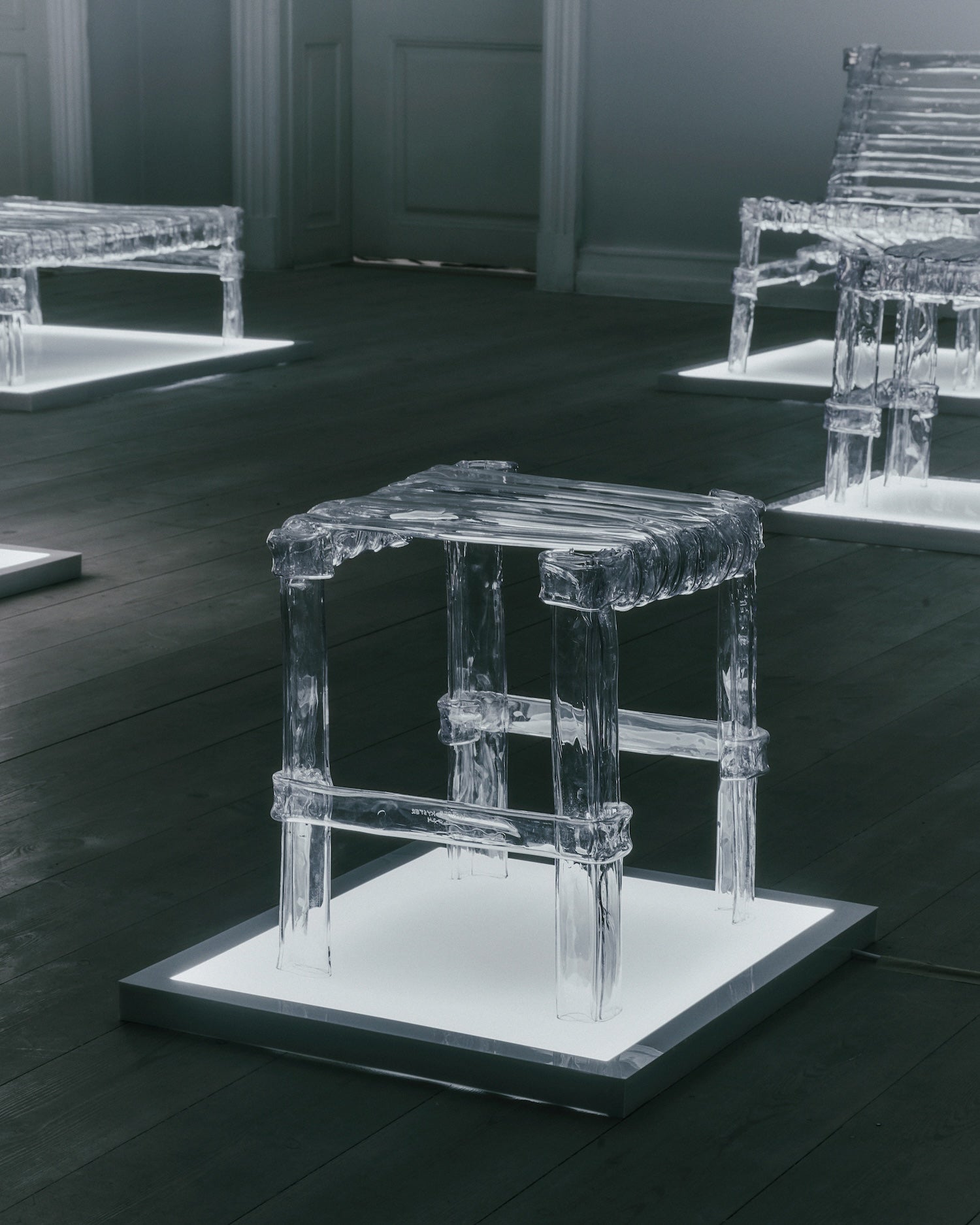
I think the important thing when creating a piece is not to create solely based on aesthetic sensibilities, but to pursue concept and functionality. In general terms, this means "form follows function." For example, the beauty of Crafting Plastic's furniture comes from the process of making the pieces. It all started with coming up with the concept of "plastic that functions as furniture." This reflects the belief that functionality is essential, not just creating something beautiful. I'm often asked if you can actually sit on plastic furniture, and of course you can. All the furniture I make is usable because I believe that furniture should be functional in the first place.

Tell us about your experience studying at The Royal Danish Academy.
I'm not familiar with design education in other regions, but I feel that there is a high degree of individual freedom in Copenhagen, where I studied. Of course there were weekly classes and presentations, but the time spent on them was not very long. The school facilities were also well-equipped with spaces and workshops where you could make various things. Learning in an environment specialized in making things allowed me to grow as a person.
At the same time, I also realized the importance of making things with my own hands. In fact, I think that's the most important thing. You can't truly understand something unless you experience the materials and techniques yourself. You need to actually get your hands dirty and experience it, not just through digital means. When making a prototype of a chair, it often looks good on the computer screen, but not in person. To get the dimensions and proportions of the furniture right, you need to make a full-scale model. And I think that repeating this process helps you improve.


The Master Collection
In Denmark, a design movement that incorporates new values and methods while preserving the traditions established by past generations is gaining attention. Are you conscious of incorporating tradition into your own work?
Yes, in fact, I think it's impossible not to incorporate it. I was born and raised in Denmark, a country with a rich traditional history. Living in Denmark, design is present everywhere, and it's impossible not to be influenced by it. I wouldn't say I consciously incorporate it into my work, but I'm certainly influenced by it. If I were to define Danish design, it would be pure manufacturing, made with excellent craftsmanship, based on the concept of "form follows function," and that's exactly what I'm working on.

The Crafting Plastic furniture you mentioned at the beginning was also exhibited at your first solo exhibition at this year's 3 Days of Design. How do you think these pieces of furniture will change the way we view plastic materials? What is the thinking behind them?
The aim was to present plastic, an industrial material that we are accustomed to seeing every day, in a completely different way. Most plastic products are injection molded for mass production, and manufacturing takes only a few seconds. However, Crafting Plastic uses a completely different method, processing plastic entirely by hand. It is processed in a very simple way that is not seen in mass production, and the result is something completely new. The beautiful and varied shapes created in this way may give new value to a material that is not usually seen as having value.


In addition to your work as a designer, you also work as a curator at Ukurant. Tell us how Ukurant started and what are the core values of your work?
Ukurant is a platform and community that primarily showcases young designers who create experimental designs. We accept submissions and exhibit the curated works during the annual 3 Days of Design. Ukurant's beginnings began when three of my classmates and I were in university and wanted to exhibit our work during the 3 Days of Design. Initially, we created a manifesto for what Ukurant should be, including statements such as "Ukurant is both an artistic and commercial endeavor," "presenting designs that connect the past and the future," and "founded by young designers, for young designers."

Ukraine 3, exhibition at 3 Days of Design. Photo by Peter William Vinther


Ukurant Perspectives, showing at 3 Days of Design. Supported by Muuto, exhibition design by Frederik Gustav. Photo by Jonas Jacob Svensson
Do you have any advice for aspiring designers?Keep experimenting. Do what you enjoy, not what others tell you to do. I also think it's important to dream big. There are many ways to do things, and each person has their own path.
Finally, New Scale asks each creator about their favorite music and how it influences them. Please tell us some of your favorite songs.
Lately, I've been listening to a lot of Danish music. I like listening to lyrics and hearing how words are transformed to give them new meaning. Furthermore, while the new generation of artists previously tended to want to make music in English, they now seem to want to make music in their native language. APHACA, a young band from Denmark that I recently discovered, explores the themes of love and anxiety that young people feel today and expresses them well in words. I'd like to introduce two songs for you: "Hjertet På Gaden" and "Våde Øjne." Although these songs are sung in Danish, the lyrics are very well written and I think they are really good at putting complex emotions into words.
Interviewer
