Interview: Arnaud Eubelen - Translating reality into sculpture while respecting the material


First, please tell us about your background and activities.
My name is Arnaud Ubelen and I'm 33 years old. I studied industrial design at the Saint-Luc Fine Arts School in Liège and La Cambre in Brussels. During my student days, I created a collective in Liège and organized music parties with large, humorous decorations. This has had a major influence on my current practice, especially my use of familiar materials. The decorations were not functional, but rather created an atmosphere and sometimes guided the audience visually. I incorporate this approach into my current work, combining design research with a more critical approach to the production and origins of objects.
My current workshop is in Molenbeek, Brussels, where I use it as a place to create and store my materials and finished works. My status as an artist guarantees me a minimum income even if I don't sell my work, but recently I've been able to sell my work regularly. My works range from small lamps to large installations that interact with architecture. I like working at different scales and making both functional and non-functional objects.


You previously mentioned in Damn Magazine that you started out doing graffiti and taking photos when you were younger. Can you tell us a bit about that time?
I've always taken photos, but over the years they have become more refined, influenced by the unique approach of the people of Liège to photography: photographing everyday, ordinary objects and highlighting the details and combinations of materials that make these objects special. Photography is my first source of inspiration for the objects I create, and I often find inspiration in architectural details and the traces left by the people in the city.
Regarding the collective you were a part of while you were a student, how did it start?
The collective was born out of economic necessity: we didn't have the money to buy materials. So we looked for free, often deteriorated materials, but it wasn't initially an aesthetic choice. Looking back, working as a collective was a big factor in allowing me to embrace my artistic practice. After finishing my design studies, I was unsure what to do next, but I think it was through the collective that I discovered my interest in sculpture and decoration. I think it was easier to embrace it because there was a shared responsibility.

You mentioned that you are from Liège, Belgium, a city with a very rich history. It was an ecclesiastical center in the Middle Ages, then an industrial center, and is now a vibrant cultural and educational center that is modernizing.
Liège is a modernizing city, deeply rooted in a declining industry. This means there are many abandoned places perfect for discovering graffiti and quiet walls. I believe that the landscape, with its emphasis on forgotten places, has had a major influence on my practice. It has encouraged me to use materials I find in the city, creating something that mirrors nature and the city.

Now, I'd like to ask you about your work, which is the main topic of this article. First, could you tell us about the ideas and concepts behind your work and activities?
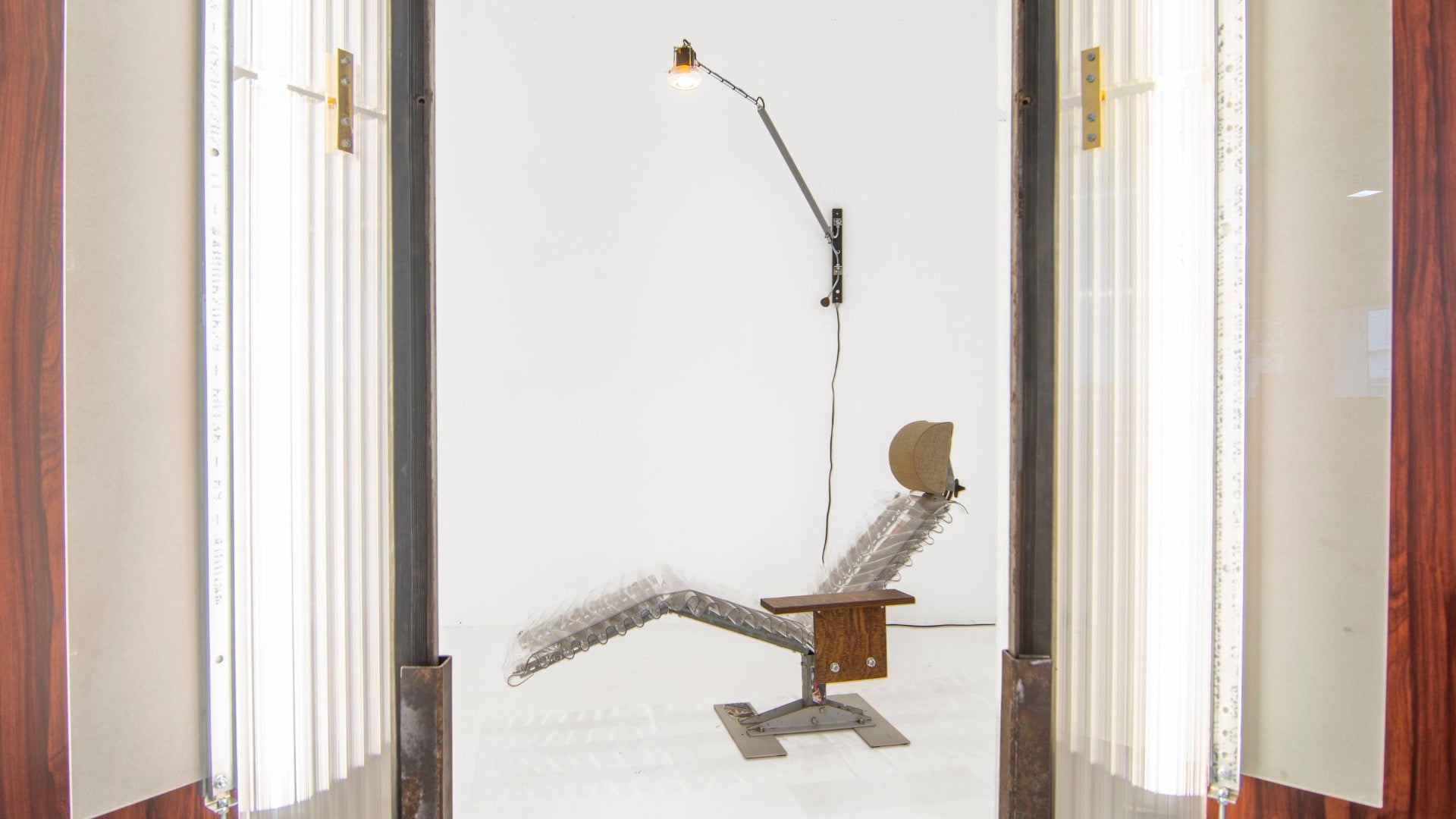
My work is heavily influenced by the objects I see in the city on a daily basis. I see taking materials directly from the city as a way to transform these objects by giving them new life. I see the city as a source of materials, just as a forester sees the forest when harvesting timber. Through my work, I try to show each layer of the object and reveal each stage of its assembly. This perhaps creates a new way of showing it, like an exploded diagram in which each element is disassembled. Broadly speaking, my approach might be to maintain the naturalness of the gesture and not hide the technique behind the assembly.
Of course, there are other influences mixed in too. I think there are many references in what I create, from the whole history of design, industrial design, furniture design, etc. Sometimes there is an homage to modernism within a single object. Other times, an object appears almost timeless, to the point that you forget when it was made. Sometimes the composition mixes materials from different eras, making it difficult to pinpoint the date of its production.

I'm curious about your design process: is it structured or more spontaneous? For example, do you always start with the material?
I don't really have a clear process. Sometimes I'm just working with functionality. For example, like any other designer, I love making chairs. Sometimes the starting point is the desire to make a chair, because I think it's a very technical and complex object, but also very symbolic.
On the other hand, since my workshop has a wide variety of materials and sizes, I often choose materials that interest me and create them myself. Or, even if I don't have a specific idea, if I find an interesting material in town, I'll bring it back to the workshop and, a few months later, an idea might come to me while I'm thinking about it.
Recently, exhibitions have often provided me with an opportunity to express myself, and I use them to think about what story I can tell through my work, and then I compose objects I have already made or add new elements to the whole.
So it's more like a case-by-case basis, and there's no defined process. Sometimes it starts with a simple order, like, "I want something of this size in this space."


You mentioned the expression "storytelling" earlier, and I felt that approach strongly while looking at your work. For example, in " What's Behind ," the viewer is invited to imagine a presence in the interstitial spaces revealed by the structural elements. In " The Chapel ," elements related to worship seem to have guided the design when creating a physical experience based on sound. In this way, it seems like the story you want to tell and the worldview you want to evoke guide your design. Do you consider this aspect to be important to your work?
That's definitely true. And it's mostly related to my own direct experiences. I think a lot of artists are inspired by their family and friends, and sometimes by the excesses and regrets they experienced when they were young. My style may be quite sharp and cold, but I try to incorporate what I've experienced into my work in a poetic way. I'm always conscious of having a certain poetic, lyric sensibility.
For example, with " The Chapel ," I've actually been going to church ever since I was a child. My father was very devout, my grandfather was a deacon, and my uncle was a priest, so I've had a connection with the church since I was little, and I think I naturally have the perspective to make use of the objects, decorations, and icons associated with the church. By trying to recreate the atmosphere I've experienced, I'm trying to create things that tell a story, rather than simply producing objects.
During our interview, I noticed that you consider your practice to be "sculpture" rather than "industrial design." Are there any movements in the history of sculpture that you are particularly interested in?
I'm fascinated by Arte Povera, and I also take inspiration from the approach to "unfinished" that classical sculptors like Rodin took. There's no one sculptor who represents everything to me, but studying the whole picture has led me to think of myself as a sculptor and artist, rather than an industrial designer.
Another point you mentioned at the beginning of the interview is humor. I think that's evident in works like " He Drank Us " and " Underground Party ," for example. Is humor something you're intentionally aiming for?
I do this intentionally. Of course, I'm not aiming to make funny works, but I am conscious of including elements that will elicit a smile. I like to laugh too, and even if a third party might not find a scene funny, I often find it funny through my own context. For example, when I see construction workers in the city trying hard to do something but doing it wrong no matter how you look at it, I find it funny. I try to capture funny situations in everyday life and recreate them in my works. In " Underground Party ," I incorporated that humor into the mirror ball.
This ties in with what you said earlier about your philosophy of incorporating things you see and experience in your daily life into your work.
That's exactly right. I haven't yet expressed it in text or conceptual writing, but the transcription of reality is a big part of the way I think about my work. In fact, I want to be close to reality even at the material level. If I'm going to use a found floorboard, I won't use it to make something that has nothing to do with walking, and if I use found window glass, I always make it vertical. I think there's a certain logic to my work, respecting the original function of the material while deconstructing its layers to make something new.
I think another major feature of your work is that you handle both the design and production yourself. Is it important to you to handle both?
I believe that this method is essential to the creation of the works I create. I think it's necessary to be aware of every stage of production, from the concept to the choice of materials, techniques, and assembly. While I adopt the "DIY" philosophy, I feel that it's closer to very high-quality, almost industrial-level DIY than simple DIY. Either way, I really like this way of working.
As I mentioned briefly at the beginning, working in a collective was a lot of fun, but ultimately compromises were always necessary. Each member's intentions had to be reflected in the work, and at some point I began to want to experiment more on my own. That's why I moved to Brussels. Working alone allows me to move forward without waiting for others, simplifies things, and I'm interested in the beauty of the objects that emerge from such an environment. For example, there is no welding in my works. I intentionally avoid waiting for something to dry or harden. I want to see results quickly, so I always try to act spontaneously and directly.

I noticed that you use prints with Japanese characters in " Stèle-Antwerpen " and " What's behind ." Have you always been interested in Japan?
Actually, I've never been to Japan, but it's a place I'd really like to visit. What sparked my curiosity was my master's thesis. I was intrigued by the emphasis on the transition from outside to inside and from inside to outside in traditional Japanese architecture, so I wrote my thesis on the threshold of the entrance.
Apart from that, there are many Japanese architects and designers who have had a great influence on me, such as Shigeru Ban, Shiro Kuramata, and of course Tadao Ando.
In addition, I used to do a residency in Antwerp, and I loved walking around the area where there were many diamond stores run by Japanese people. It was unusual to see Japanese in Belgium, and I liked the novelty of it.
The prints used in " Stèle-Antwerpen " and " What's behind " are actually the same photographs. I evolve the sculpture every year using salvaged elements.
Music-wise, I'd say I listen to a pretty wide variety of genres: from Mobb Deep to Banco de Gaia, Autechre, John Coltrane, Sade, Isaac Hayes, Jorge Ben, and of course Mylène Farmer and Cocteau Twins!
Can you tell us a bit about the new work you're currently finalizing?
I'm planning to hold an exhibition at the gallery SUPER DAKOTA in Brussels. The concept of the exhibition is to use everyday objects as motifs, and I plan to create a "car" that uses a rusted metal car as its motif, but omits the body, steering wheel, engine, doors, etc. It will have two seats with a sound system, and I hope to recreate the feeling of listening to music in a car without the car.
I am also working on a project with the National Theatre in Brussels, where I will be creating a luminous sculpture from a stage set that has been in storage for years. I am aiming for the sculpture to function as a lighting fixture as well.
